
2021年的诺贝尔生理学或医学奖
2021年10月4日,卡罗林斯卡学院诺贝尔大会决定将2021年诺贝尔生理学或医学奖共同授予 David Julius 和 Ardem Patapoutian,以表彰他们在“发现温度与触觉感受器”方面的卓越贡献。千百年来,人类如何通过躯体感觉来感知物理世界这一问题,始终令人着迷。20世纪上半叶,人们已明确温度和压力能激活皮肤中不同类型的神经。然而,在感觉神经系统中,究竟是哪些分子转导器负责检测并将热、冷及触觉转化为神经冲动,这一谜题直到这年诺奖所表彰的发现才得以解开。
从粒子运动到神经传导
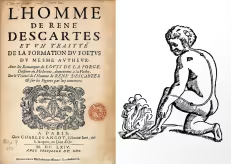
躯体感觉千百年来一直令人类着迷。为解释我们对热的反应,17世纪哲学家René Descartes曾描绘“火之粒子”牵拉皮肤与大脑之间连线的场景[1]。
19世纪80年代,研究发现皮肤上存在特定的感觉点,能对触摸、热或冷等特定刺激作出反应,这表明不同刺激激活的是不同类型的神经[2,3]。此后三项诺贝尔生理学或医学奖显著推进了我们对躯体感觉神经系统的理解。1906年,Camillo Golgi 和 Santiago Ramón y Cajal 因在神经系统结构方面的工作(包括对躯体感觉系统的解剖学描述)获奖。1932年, Sir Charles Sherrington 和 Edgar Adrian 因关于神经元功能的发现(包括对躯体感觉神经元的描述)获奖。1944年,Joseph Erlanger 和 Herbert Spencer Gasser 因发现单一躯体感觉神经纤维的分化功能而获奖。这些发现确立了动作电位沿皮肤和肌肉感觉神经纤维传导的重要原则。然而,根本性问题仍未解决:能够感知温度和触觉的感受器,其本质究竟是什么?这些传感器又是如何将刺激转化为躯体感觉神经纤维中的动作电位的呢?
热敏感离子通道与温度感觉的发现
辣椒素(8-甲基-N-香草基-6-壬烯酰胺)是辣椒的活性成分,食用辛辣食物时的灼烧感便源于此。对这种化学物质的研究提供了重要基础,为第一个热敏感感受器的发现打开了大门。20世纪50年代的研究表明,当辣椒接触口腔或嘴唇时会引发头部出汗,这种现象被称为味觉性出汗[4]。在接下来的几十年里,研究发现辣椒素作用于感觉神经[5]并能诱导离子电流[6,9]。与此同时,也有研究表明有害热能激活感觉神经元中的离子通道[10,11]。然而,通道本身是否就是热能的转导器,当时尚不完全清楚。
TRPV1作为感觉神经元中热敏感离子通道的发现
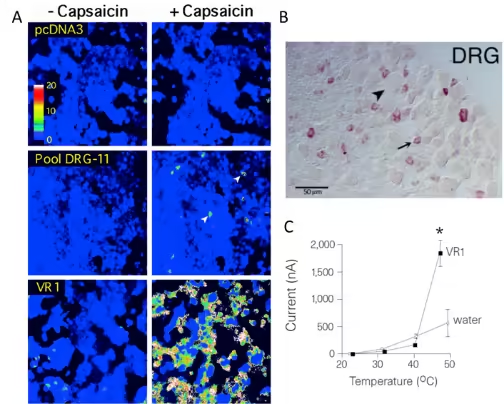
20世纪90年代末,加州大学旧金山分校的David Julius致力于鉴定辣椒素受体。他们团队利用对辣椒素敏感的感觉神经元构建了cDNA文库,认为该文库中包含一段能编码对辣椒素起反应的蛋白质的DNA片段。随后,他们将对辣椒素不敏感的细胞用这批cDNA转染后,最终分离出了一个能赋予辣椒素反应性的单一cDNA克隆[12] (图2A)。感应辣椒素的基因就此被发现!预测该分离基因编码一种具有六个跨膜结构域的整合膜蛋白,同源性搜索显示它属于瞬时受体电位(TRP)阳离子通道超家族[13, 14]。Julius继续通过在细胞中异位表达来对TRPV1受体(当时称为香草酸受体1,VR1)进行功能表征,发现辣椒素诱发的电生理特性与天然感觉神经元中的通道相似。他还注意到转染细胞对辣椒素诱导的细胞毒性效应变得敏感,且辣椒素诱发的反应可被拮抗剂阻断。这一新发现的辣椒素受体后来被命名为TRPV1。
进一步表征显示,TRPV1表达于伤害性背根神经节神经元中,这解释了辣椒素对这些细胞的选择性作用(图2B)。在探索TRPV1生理学特性的过程中,Julius检测了其对升温的敏感性,发现热可引起显著的激活并导致细胞Ca²⁺内流。利用膜片钳直接测量电流,揭示了一种特异性的热诱发膜电流,其特性与感觉神经元中的电流相似。此外,TRPV1的激活阈值(高于40°C)接近热痛的心理物理阈值(图2C)。
1997年TRPV1作为辣椒素和热激活离子通道的奠基性发现,开辟了该领域,标志着我们在探索温度感知的分子与神经基础道路上的一座里程碑[15-19]。
TRPV1及其他TRP通道的整体跨膜拓扑结构和亚基架构与电压门控钠、钾通道相似[20, 21]。Julius实验室与程亦凡实验室合作,利用冷冻电镜解析了TRPV1的结构。TRPV1似乎具有两个门控,在阳离子传导孔的两端形成两个显著的物理狭窄[22, 23]。辣椒素结合于TRPV1深处靠近胞质侧的膜内口袋。一项最新结构研究表明,有害热会在辣椒素结合的TRPV1通道中引发两次构象门控转变[24]:第一次转变为通道开放做准备,第二次则导致通道开放。TRPV1通道的结构研究为其离子渗透、配体识别和门控机制提供了重要洞见,但其热激活机制在结构层面尚未完全阐明。
后来在2011年,Voets团队在Trpv1敲除小鼠中鉴定出TRPM3作为第二种有害热传感器[25]。最后,Voets团队证明小鼠的有害热感知依赖于三种离子通道(即TRPV1、TRPM3和2004年被Julius和Patapoutian实验室各自独立地发现为辛辣化学物质的转导器放入TRPA1)的组合,这一问题才得以解决。
TRPV1的发现是一项重大突破,为揭示更多温度感应受体铺平了道路。2002年,Julius和Patapoutian实验室各自独立地发现了冷的感受器TRPM8[26, 27]。他们利用一种能在人类中引发无害凉爽感的天然化合物——薄荷醇,筛选出结合的离子通道并且也能被低温激活。并发现其在异源表达系统中能被低温激活,激活温度范围恰与人类感知无害冷的范围一致[26, 27]。
此后,更多与TRPV1和TRPM8相关的离子通道被发现,并被证实能被一系列不同温度所激活。众多实验室利用缺失这些新发现基因的转基因小鼠开展研究,深入探究这些通道在温度感觉中的作用。David Julius对TRPV1的发现,正是让我们理解温差如何在神经系统中诱发电信号的关键突破口。
脊椎动物机械敏感离子通道的发现
就在温度感觉机制逐渐明朗之际,另一个谜题依然存在,就是机械刺激是如何转化为触觉和压觉的?
尽管40多年前,基于青蛙耳蜗毛细胞受机械刺激后快速膜去极化的数据,学界就首次提出脊椎动物机械敏感离子通道存在的假说[28]。但直到20世纪80年代末才在大肠杆菌中得到证实[29, 30, 31]。而脊椎动物触觉背后的分子机制依然成谜。
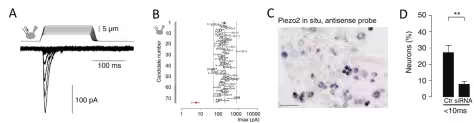
Ardem Patapoutian开发了一种新颖的筛选方法,他与博士后伯特兰·科斯特Bertrand Coste发现了一种名为Neuro2A的细胞系[32],当用微量移液管戳刺单个细胞时,会产生可测量的电信号。他们推测这是一种机械敏感离子通道,并据此筛选出72个可能编码此通道的基因。通过RNA干扰逐一沉默这些基因,他们找出了导致所研究细胞丧失机械敏感性的那个关键基因。
一种全新且此前未知的机械敏感离子通道就此被发现,并以希腊语中表示“压力”的词汇(píesi)命名为PIEZO1。Patapoutian还进一步证明,PIEZO1的异位表达使人胚肾细胞(HEK-293)获得了机械敏感性,对质膜施加压力可在这些细胞中诱导大电流。随后,通过序列同源性发现了第二种机械敏感通道PIEZO2。
新鉴定的PIEZO通道属于一个此前未知的蛋白质家族,存在于脊椎动物及许多其他真核生物中。研究发现PIEZO2表达于背根神经节感觉神经元中(图3C),而PIEZO2的敲低则消除了这些感觉神经元的机械敏感性(图3D)。
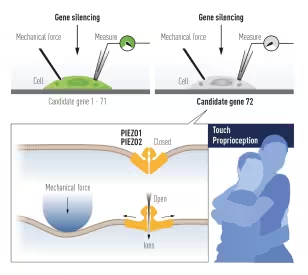
PIEZO蛋白代表了一类全新的脊椎动物机械敏感通道,与任何已知离子通道家族均无相似之处。它们是迄今为止鉴定的最大跨膜离子通道亚基,由2500个氨基酸组成,展现出独特的38次跨膜螺旋拓扑结构。Patapoutian及其他实验室的工作揭示了PIEZO1和PIEZO2的高分辨率结构,显示这些通道形成同源三聚体结构,具有中央离子传导孔和三个外围的大型机械感应螺旋桨状叶片[33-36]。这三个叶片向外向上弯曲,在细胞膜表面形成纳米碗状构型[35-37]。当机械力施加于膜上时,弯曲的叶片展平,导致中央孔开放。这种带有弯曲叶片的螺旋桨状结构产生了巨大的平面内膜面积扩张,这可能解释了PIEZO通道精妙的机械敏感性[35, 38]。然而,机械力打开中央孔的确切机制仍未完全明了。凭借其机械敏感性,PIEZO通道在许多细胞类型中充当多功能机械转导器,将机械力转化为电化学信号(图4)。
PIEZO通道的生理意义远超触觉本身。1938年,诺贝尔生理学或医学奖授予 Corneille Heymans,以表彰其发现迷走神经在反射(包括Hering-Breuer描述的呼吸反射)中的感觉功能。Patapoutian实验室与其他研究组合作表明,成年小鼠内脏迷走神经神经元中PIEZO2的缺失会导致Hering-Breuer反射受损并增加呼吸潮气量。此外,发育期间PIEZO2的缺失会导致出生时呼吸窘迫和死亡[39]。因此,存在于支气管和细支气管壁肺牵张受体上的PIEZO2通道可被深吸气激活,并启动保护肺部免受过度膨胀的反射。
此外,动脉压力感受性反射依赖于迷走和吞咽神经节中PIEZO1与PIEZO2的共同作用,缺失二者的小鼠会出现类似人类压力感受性衰竭的不稳定高血压[40,41]。
在胃肠道中,PIEZO2使肠嗜铬细胞能响应腔内容物的机械刺激而释放激素[42,43]。
在泌尿系统中,它则是膀胱感觉神经元的关键机械传感器,缺失会导致排尿障碍[44]。
PIEZO1还在小鼠血管内皮、红细胞和成骨细胞中发挥重要作用,参与血管形成、血压调节、红细胞体积稳态以及骨重塑等过程[42-53]。
对人类及医学的意义
人类中存在数种遗传性“TRP通道病”。在温度感应TRP通道中,一种名为家族性阵发性疼痛综合征1型的常染色体显性TRPA1通道病由TRPA1点突变引起,表现为由寒冷、禁食和体力应激引发的 debilitating(使人衰弱的)上身疼痛发作[54]。多项研究调查了TRP通道基因单核苷酸多态性(SNPs)的作用,发现TRPA1 710G>A与神经病理性疼痛及反常热感觉相关。此外,TRPV1 1911A>G与冷痛觉减退相关[55],而TRPV1中的其他几个SNPs则改变了对辣椒素的敏感性。
Patapoutian及其他多位研究者报道,PIEZO2基因突变是多种遗传疾病的病因,表现为触觉、振动觉及本体感觉的改变。虽然缺乏PIEZO2的小鼠因呼吸窘迫而在出生时死亡,但携带双等位基因功能缺失突变的人类却能存活。PIEZO2基因的功能缺失突变导致一种名为远端关节挛缩症(DA)的常染色体隐性遗传病,伴有手指、足部和脚趾多关节先天性挛缩,以及本体感觉和触觉受损(DAIPT)[56]。随着世界各地更多DAIPT家系的报道及对表型表现的更好理解,“PIEZO2缺乏综合征”这一替代名称应运而生。PIEZO2缺乏综合征患者的本体感觉、触觉和振动觉显著减弱。这导致感觉性共济失调、辨距不良、步态困难、肌无力与萎缩、脊柱侧弯、髋关节发育不良及进行性骨骼挛缩。这些患者还存在来自肺部的内感受缺陷,导致围产期呼吸窘迫;以及来自膀胱的内感受缺陷,导致排尿障碍。这些患者在皮肤炎症后无法发展出对触觉的敏化和疼痛反应,表明PIEZO2在触觉异常性疼痛中起关键作用[57]。然而,PIEZO2缺乏综合征患者保留了无害深压觉[58]和有害机械痛反应[59]。
PIEZO2的功能获得性突变导致常染色体显性DA 5型,这是一种以显著眼运动症状为特征的亚型[60, 61]。其他常染色体显性突变导致DA 3型,也称Gordon综合征[61, 62],其区别于其他远端关节挛缩症的特征是身材矮小和腭裂。PIEZO2功能获得性突变也在Marden-Walker综合征中被报道,这是一种以精神运动发育迟缓、小颌畸形和脊柱后侧凸为特征的DA亚型[61]。
缺乏PIEZO1的小鼠在胚胎期死亡,而携带双等位基因功能缺失突变的人类却能存活。Patapoutian及其他研究者表明,PIEZO1的双等位基因功能缺失突变或复合杂合突变会导致一种常染色体隐性遗传的独特全身性淋巴发育不良,称为淋巴畸形6型[63, 64]。其特征为面部和肢体普遍淋巴水肿,表明PIEZO1参与了相应淋巴结构的发育。
PIEZO1的功能获得性突变导致一种名为脱水性遗传性口形红细胞增多症(DHS)或遗传性干红细胞症的常染色体显性溶血性贫血[65-67]。这种贫血的特征是大红细胞症、口形红细胞的存在及红细胞脱水。脱水是由细胞阳离子含量缺陷引起的,部分患者表现为假性高钾血症。导致DHS的点突变已被发现位于PIEZO1蛋白C端半部的高度保守残基处。Patapoutian已证明,功能获得性E756del PIEZO1等位基因会导致红细胞脱水并降低严重恶性疟原虫感染的风险[68, 69]。该等位基因在非洲人群中高度流行且富集,这提出了它可能因疟疾而受到正向选择的可能性。E756del PIEZO1等位基因还与非洲个体红细胞周转增加及血清铁升高相关[70]。
结语
总结来说,两位诺奖得主对TRPV1、TRPM8及PIEZO通道的开创性发现,终于让我们理解了热、冷和机械力如何启动神经冲动,使我们得以感知并适应这个世界。TRP通道是温度感知的核心,PIEZO2则赋予了我们触觉和本体感觉。更重要的是,这些通道还广泛参与众多生理过程。当前,基于这些发现的密集研究正在展开,相关成果有望为慢性疼痛等多种疾病带来全新的治疗方案。
参考文献:
[1] DeLeo J A. Basic science of pain[J]. JBJS, 2006, 88(suppl_2): 58-62.
[2] Melzack R, Wall P D. On the nature of cutaneous sensory mechanisms[J]. Brain, 1962, 85(2): 331-356.
[3] Norrsell U, Finger S, Lajonchere C. Cutaneous sensory spots and the “law of specific nerve energies”: history and development of ideas[J]. Brain research bulletin, 1999, 48(5): 457-465.
[4] Lee T S. Physiological gustatory sweating in a warm climate[J]. The Journal of physiology, 1954, 124(3): 528.
[5] Jancó G, Kiraly E, Jancsó-Gábor A. Pharmacologically induced selective degeneration of chemosensitive primary sensory neurones[J]. Pain, 1980, 8(1): 124-125.
[6] Dray A, Bettaney J, Forster P. Actions of capsaicin on peripheral nociceptors of the neonatal rat spinal cord‐tail in vitro: dependence of extracellular ions and independence of second messengers[J]. British Journal of Pharmacology, 1990, 101(3): 727-733.
[7] Marsh S J, Stansfeld C E, Brown D A, et al. The mechanism of action of capsaicin on sensory C-type neurons and their axons in vitro[J]. Neuroscience, 1987, 23(1): 275-289.
[8] Szallasi A, Blumberg P M. Specific binding of resiniferatoxin, an ultrapotent capsaicin analog, by dorsal root anglion membranes[J]. Brain research, 1990, 524(1): 106-111.
[9] Wood J N, Winter J, James I F, et al. Capsaicin-induced ion fluxes in dorsal root ganglion cells in culture[J]. The Journal of neuroscience, 1988, 8(9): 3208-3220.
[10] Cesare P, McNaughton P. A novel heat-activated current in nociceptive neurons and its sensitization by bradykinin[J]. Proceedings of the National Academy of Sciences, 1996, 93(26): 15435-15439.
[11] Reichling D B, Levine J D. Heat transduction in rat sensory neurons by calcium-dependent activation of a cation channel[J]. Proceedings of the National Academy of Sciences, 1997, 94(13): 7006-7011.
[12] Caterina M J, Schumacher M A, Tominaga M, et al. The capsaicin receptor: a heat-activated ion channel in the pain pathway[J]. Nature, 1997, 389(6653): 816-824.
[13] Clapham D E. TRP channels as cellular sensors[J]. Nature, 2003, 426(6966): 517-524.
[14] Voets T, Talavera K, Owsianik G, et al. Sensing with TRP channels[J]. Nature chemical biology, 2005, 1(2): 85-92.
[15] Tominaga M, Caterina M J, Malmberg A B, et al. The cloned capsaicin receptor integrates multiple pain-producing stimuli[J]. Neuron, 1998, 21(3): 531-543.
[16] Caterina M J, Leffler A, Malmberg A B, et al. Impaired nociception and pain sensation in mice lacking the capsaicin receptor[J]. science, 2000, 288(5464): 306-313.
[17] Davis J B, Gray J, Gunthorpe M J, et al. Vanilloid receptor-1 is essential for inflammatory thermal hyperalgesia[J]. Nature, 2000, 405(6783): 183-187.
[18] Fernández-Carvajal A, González-Muñiz R, Fernández-Ballester G, et al. Investigational drugs in early phase clinical trials targeting thermotransient receptor potential (thermoTRP) channels[J]. Expert opinion on investigational drugs, 2020, 29(11): 1209-1222.
[19] Manitpisitkul P, Mayorga A, Shalayda K, et al. Safety, tolerability and pharmacokinetic and pharmacodynamic learnings from a double-blind, randomized, placebo-controlled, sequential group first-in-human study of the TRPV1 antagonist, JNJ-38893777, in healthy men[J]. Clinical Drug Investigation, 2015, 35(6): 353-363.
[20] Catterall W A, Wisedchaisri G, Zheng N. The chemical basis for electrical signaling[J]. Nature chemical biology, 2017, 13(5): 455-463.
[21] Long S B, Tao X, Campbell E B, et al. Atomic structure of a voltage-dependent K+ channel in a lipid membrane-like environment[J]. Nature, 2007, 450(7168): 376-382.
[22] Cao E, Liao M, Cheng Y, et al. TRPV1 structures in distinct conformations reveal activation mechanisms[J]. Nature, 2013, 504(7478): 113-118.
[23] Liao M, Cao E, Julius D, et al. Structure of the TRPV1 ion channel determined by electron cryo-microscopy[J]. Nature, 2013, 504(7478): 107-112.
[24] Kwon D H, Zhang F, Suo Y, et al. Heat-dependent opening of TRPV1 in the presence of capsaicin[J]. Nature structural & molecular biology, 2021, 28(7): 554-563.
[25] Vriens J, Owsianik G, Hofmann T, et al. TRPM3 is a nociceptor channel involved in the detection of noxious heat[J]. Neuron, 2011, 70(3): 482-494.
[26] McKemy D D, Neuhausser W M, Julius D. Identification of a cold receptor reveals a general role for TRP channels in thermosensation[J]. Nature, 2002, 416(6876): 52-58.
[27] Peier A M, Moqrich A, Hergarden A C, et al. A TRP channel that senses cold stimuli and menthol[J]. Cell, 2002, 108(5): 705-715.
[28] Corey D P, Hudspeth A J. Response latency of vertebrate hair cells[J]. Biophysical journal, 1979, 26(3): 499-506.
[29] Martinac B, Buechner M, Delcour A H, et al. Pressure-sensitive ion channel in Escherichia coli[J]. Proceedings of the National Academy of Sciences, 1987, 84(8): 2297-2301.
[30] Delcour A H, Martinac B, Adler J, et al. Modified reconstitution method used in patch-clamp studies of Escherichia coli ion channels[J]. Biophysical journal, 1989, 56(3): 631-636.
[31] Sukharev S I, Blount P, Martinac B, et al. A large-conductance mechanosensitive channel in E. coli encoded by mscL alone[J]. Nature, 1994, 368(6468): 265-268.
[32] Coste B, Mathur J, Schmidt M, et al. Piezo1 and Piezo2 are essential components of distinct mechanically activated cation channels[J]. Science, 2010, 330(6000): 55-60.
[33] Ge J, Li W, Zhao Q, et al. Architecture of the mammalian mechanosensitive Piezo1 channel[J]. Nature, 2015, 527(7576): 64-69.
[34] Saotome K, Murthy S E, Kefauver J M, et al. Structure of the mechanically activated ion channel Piezo1[J]. Nature, 2018, 554(7693): 481-486.
[35] Wang L, Zhou H, Zhang M, et al. Structure and mechanogating of the mammalian tactile channel PIEZO2[J]. Nature, 2019, 573(7773): 225-229.
[36] Zhao Q, Zhou H, Chi S, et al. Structure and mechanogating mechanism of the Piezo1 channel[J]. Nature, 2018, 554(7693): 487-492.
[37] Guo Y R, MacKinnon R. Structure-based membrane dome mechanism for Piezo mechanosensitivity[J]. elife, 2017, 6: e33660.
[38] Jiang Y, Yang X, Jiang J, et al. Structural designs and mechanogating mechanisms of the mechanosensitive piezo channels[J]. Trends in biochemical sciences, 2021, 46(6): 472-488.
[39] Nonomura K, Woo S H, Chang R B, et al. Piezo2 senses airway stretch and mediates lung inflation-induced apnoea[J]. Nature, 2017, 541(7636): 176-181.
[40] Min S, Chang R B, Prescott S L, et al. Arterial baroreceptors sense blood pressure through decorated aortic claws[J]. Cell reports, 2019, 29(8): 2192-2201. e3.
[41] Zeng W Z, Marshall K L, Min S, et al. PIEZOs mediate neuronal sensing of blood pressure and the baroreceptor reflex[J]. Science, 2018, 362(6413): 464-467.
[42] Alcaino C, Knutson K R, Treichel A J, et al. A population of gut epithelial enterochromaffin cells is mechanosensitive and requires Piezo2 to convert force into serotonin release[J]. Proceedings of the National Academy of Sciences, 2018, 115(32): E7632-E7641.
[43] Wang F, Knutson K, Alcaino C, et al. Mechanosensitive ion channel Piezo2 is important for enterochromaffin cell response to mechanical forces[J]. The Journal of physiology, 2017, 595(1): 79-91.
[44] Marshall K L, Saade D, Ghitani N, et al. PIEZO2 in sensory neurons and urothelial cells coordinates urination[J]. Nature, 2020, 588(7837): 290-295.
[45] Li J, Hou B, Tumova S, et al. Piezo1 integration of vascular architecture with physiological force[J]. Nature, 2014, 515(7526): 279-282.
[46] Ranade S S, Qiu Z, Woo S H, et al. Piezo1, a mechanically activated ion channel, is required for vascular development in mice[J]. Proceedings of the National Academy of Sciences, 2014, 111(28): 10347-10352.
[47] Retailleau K, Duprat F, Arhatte M, et al. Piezo1 in smooth muscle cells is involved in hypertension-dependent arterial remodeling[J]. Cell reports, 2015, 13(6): 1161-1171.
[48] Rode B, Shi J, Endesh N, et al. Piezo1 channels sense whole body physical activity to reset cardiovascular homeostasis and enhance performance[J]. Nature communications, 2017, 8(1): 350.
[49] Wang S P, Chennupati R, Kaur H, et al. Endothelial cation channel PIEZO1 controls blood pressure by mediating flow-induced ATP release[J]. The Journal of clinical investigation, 2016, 126(12): 4527-4536.
[50] Cahalan S M, Lukacs V, Ranade S S, et al. Piezo1 links mechanical forces to red blood cell volume[J]. elife, 2015, 4: e07370.
[51] Li X, Han L, Nookaew I, et al. Stimulation of Piezo1 by mechanical signals promotes bone anabolism[J]. elife, 2019, 8: e49631.
[52] Sun W, Chi S, Li Y, et al. The mechanosensitive Piezo1 channel is required for bone formation[J]. elife, 2019, 8: e47454.
[53] Wang L, You X, Lotinun S, et al. Mechanical sensing protein PIEZO1 regulates bone homeostasis via osteoblast-osteoclast crosstalk[J]. Nature communications, 2020, 11(1): 282.
[54] Kremeyer B, Lopera F, Cox J J, et al. A gain-of-function mutation in TRPA1 causes familial episodic pain syndrome[J]. Neuron, 2010, 66(5): 671-680.
[55] Binder A, May D, Baron R, et al. Transient receptor potential channel polymorphisms are associated with the somatosensory function in neuropathic pain patients[J]. PloS one, 2011, 6(3): e17387.
[56] Delle Vedove A, Storbeck M, Heller R, et al. Biallelic loss of proprioception-related PIEZO2 causes muscular atrophy with perinatal respiratory distress, arthrogryposis, and scoliosis[J]. The American Journal of Human Genetics, 2016, 99(5): 1206-1216.
[57] Szczot M, Liljencrantz J, Ghitani N, et al. PIEZO2 mediates injury-induced tactile pain in mice and humans[J]. Science translational medicine, 2018, 10(462): eaat9892.
[58] Case L K, Liljencrantz J, Madian N, et al. Innocuous pressure sensation requires A-type afferents but not functional ΡΙΕΖΟ2 channels in humans[J]. Nature communications, 2021, 12(1): 657.
[59] Nagi S S, Marshall A G, Makdani A, et al. An ultrafast system for signaling mechanical pain in human skin[J]. Science advances, 2019, 5(7): eaaw1297.
[60] Coste B, Houge G, Murray M F, et al. Gain-of-function mutations in the mechanically activated ion channel PIEZO2 cause a subtype of Distal Arthrogryposis[J]. Proceedings of the National Academy of Sciences, 2013, 110(12): 4667-4672.
[61] McMillin M J, Beck A E, Chong J X, et al. Mutations in PIEZO2 cause Gordon syndrome, Marden-Walker syndrome, and distal arthrogryposis type 5[J]. The American Journal of Human Genetics, 2014, 94(5): 734-744.
[62] Alisch F, Weichert A, Kalache K, et al. Familial Gordon syndrome associated with a PIEZO2 mutation[J]. American journal of medical genetics Part A, 2017, 173(1): 254-259.
[63] Fotiou E, Martin-Almedina S, Simpson M A, et al. Novel mutations in PIEZO1 cause an autosomal recessive generalized lymphatic dysplasia with non-immune hydrops fetalis[J]. Nature communications, 2015, 6(1): 8085.
[64] Lukacs V, Mathur J, Mao R, et al. Impaired PIEZO1 function in patients with a novel autosomal recessive congenital lymphatic dysplasia[J]. Nature communications, 2015, 6(1): 8329.
[65] Albuisson J, Murthy S E, Bandell M, et al. Dehydrated hereditary stomatocytosis linked to gain-of-function mutations in mechanically activated PIEZO1 ion channels[J]. Nature communications, 2013, 4(1): 1884.
[66] Andolfo I, Alper S L, De Franceschi L, et al. Multiple clinical forms of dehydrated hereditary stomatocytosis arise from mutations in PIEZO1[J]. Blood, The Journal of the American Society of Hematology, 2013, 121(19): 3925-3935.
[67] Zarychanski R, Schulz V P, Houston B L, et al. Mutations in the mechanotransduction protein PIEZO1 are associated with hereditary xerocytosis[J]. Blood, The Journal of the American Society of Hematology, 2012, 120(9): 1908-1915.
[68] Ma S, Cahalan S, LaMonte G, et al. Common PIEZO1 allele in African populations causes RBC dehydration and attenuates plasmodium infection[J]. Cell, 2018, 173(2): 443-455. e12.
[69] Hill A V S, Allsopp C E M, Kwiatkowski D, et al. Common West African HLA antigens are associated with protection from severe malaria[J]. Nature, 1991, 352(6336): 595-600.
[70] Ma S, Dubin A E, Zhang Y, et al. A role of PIEZO1 in iron metabolism in mice and humans[J]. Cell, 2021, 184(4): 969-982. e13.